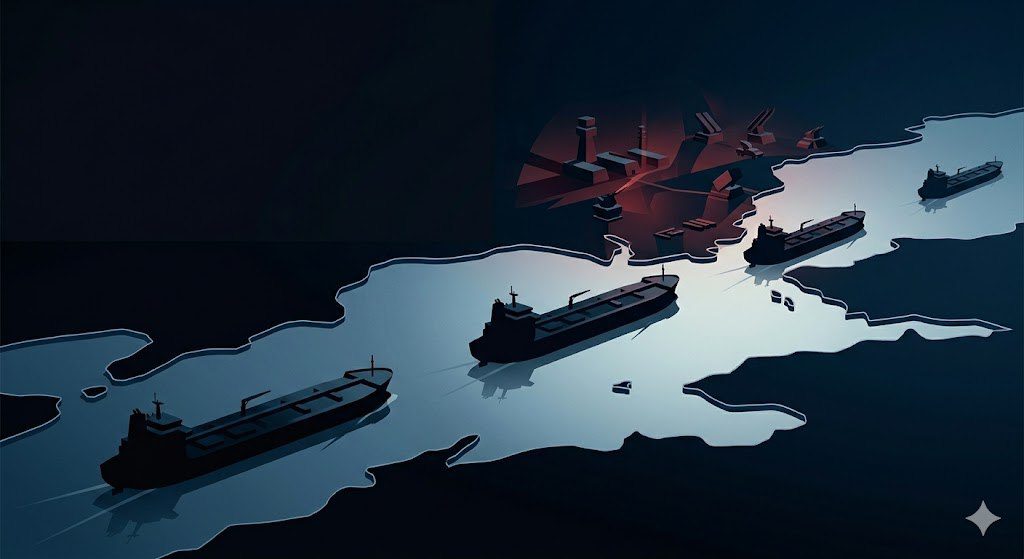
The Hormuz Blockade Just Became a Regional Shakedown
Hard-news summary
Reuters reported on April 13 that the United States will begin blockading vessels leaving Iranian ports after talks with Tehran failed to produce a settlement, and Iran answered by threatening retaliation against Gulf ports if its own ports are targeted. The move follows a fragile ceasefire that halted six weeks of U.S. and Israeli strikes but left the Strait of Hormuz effectively constrained. Reuters said two Iranian-linked tankers slipped out before the blockade took effect and that oil prices jumped back above $100 as markets priced in a longer disruption.
The practical story is broader than the military wording. Reuters noted that Iran has demanded recognition of its control over the strait, sanctions relief, and a U.S. military pullback from regional bases, while Washington says Tehran rejected its core demands. In plain English, the diplomacy did not remove the choke point. It just exposed it. The result is a live regional power struggle over who controls passage, who absorbs the risk, and who ends up paying the higher bill for fuel, shipping, and ordinary goods.
Commentary
The easiest way to sanitize a power struggle is to write it in legal language. That is what officials are doing here. The blockade is being described as an enforcement step aimed at vessels leaving Iranian ports. Tehran is calling any restrictions in international waters piracy. Both sides are wrapping the move in justification. But for normal readers, the clean question is simpler: who is turning a global trade route into leverage, and who is going to pay for it?
That is why Tom is the right lens. The core of this story is sovereignty. A chokepoint only matters politically when somebody can weaponize it. The Strait of Hormuz is not just a line on a map. It is one of the places where elite strategy turns into very ordinary pain. If passage becomes conditional, pricing becomes political. If pricing becomes political, the cost does not stay inside defense briefings. It moves into fuel, freight, food, airfare, and every other bill that depends on energy moving normally.
Reuters' reporting makes the real point harder to hide. The ceasefire exists on paper, but the structure of coercion is still intact. Two Iranian-linked tankers rushed out before the blockade began. Oil snapped higher again. Tehran is openly warning neighboring ports. Washington is still talking about enforcement and future talks in the same breath. That is not stability. That is managed instability with a public-relations wrapper on top.
This is where most mainstream coverage drifts into military play-by-play and loses the citizen angle. Readers do not need another round of chest-thumping about who looked stronger in Islamabad. They need to understand that once a state uses a narrow shipping corridor as a bargaining chip, the invoice spreads outward fast. Insurance gets pricier. Traders demand a larger premium. Companies buy more defensively. Governments talk about security. Households get the higher monthly bill.
The corruption in stories like this is often narrative corruption. Officials present the pressure as targeted and limited, then act surprised when the market refuses to believe them. Markets are not interested in the tidiness of the statement. They care whether ships will move, whether insurers will cover the route cheaply, and whether a fresh round of escalation is only one bad decision away. When oil is back over $100 and shipping behavior changes before the blockade is fully underway, the market is telling you the official reassurance is not enough.
Tom's strength is insisting that power is never abstract for long. A government can call this deterrence, retaliatory signaling, or maritime enforcement. Fine. But if the result is that one of the most important energy chokepoints on earth becomes a regional tollbooth again, then the public should treat this as a domestic affordability story too. The people making the move will talk about order. The people living downstream will feel disorder in the price system.
There is also a deeper accountability problem underneath the geopolitics. Washington wants to act like it can preserve strategic leverage without owning the economic side effects. Tehran wants to project strength without admitting how much economic damage prolonged disruption does to everyone tied to Gulf shipping. Gulf neighbors want security without being dragged into direct retaliation. Every player wants leverage. Nobody wants the household-level invoice attached to their name.
That is why the cleanest description of this moment is a shakedown. Not because one side is innocent and the other guilty, but because the route itself is being converted into pressure. Once that happens, the whole region starts operating like movement has a political toll attached. And in modern politics, tolls rarely get paid by the people announcing them. They get paid by people trying to fill a tank, run a business, or keep a family budget intact while leaders explain why this latest disruption is regrettable but necessary.
The smart way to read the Reuters story is not as a narrow naval update. It is as a warning that the choke point is still live, the ceasefire never solved the structure, and the cost pipeline is already reopening. When governments turn geography into leverage, ordinary people always discover how expensive strategy can be.
Where to go next
For the deeper operating logic behind this story, move into Analysis. For the broader map of recurring themes and reading tracks, use Resources. If you have evidence, receipts, or a correction, use the tipline.