Washington Is Playing Chicken in Hormuz and Pretending Your Cost Comes Later.
By Tom
News Summary
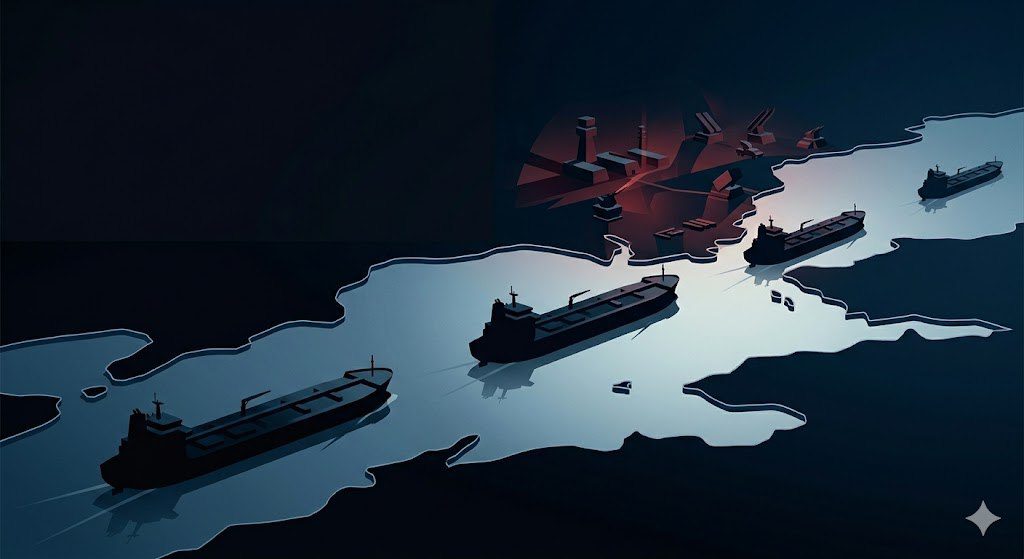
The Strait of Hormuz is back at the center of the global economy, and not because diplomats settled anything. On April 18, U.S. Central Command said American forces had turned back at least 23 vessels as part of a blockade on Iranian ports and coastal areas that began on April 13. Coverage carried by The Business Standard said all 23 vessels complied, while the U.S. military described the operation as active enforcement in one of the world’s most sensitive shipping corridors. At the same time, Reuters reported ships attempting to cross reported gunfire, and Iran said it had reimposed strict control over the strait.
That is not some distant regional quarrel. The Strait of Hormuz is a critical artery for oil and other energy shipments. When Washington and Tehran start testing each other there, the immediate issue is not only military signaling. It is who gets to decide what counts as safe passage, what counts as acceptable risk, and how much uncertainty the rest of the world is expected to absorb. Once shipping risk spikes, ordinary people eventually feel it through fuel, transport, insurance, and the price of everything that depends on them.
Worldview Commentary
The easiest way to misunderstand the Strait of Hormuz is to treat it like one more faraway crisis that only matters if missiles start flying on live television. That is how the political class prefers it. If the public sees Hormuz as a distant map problem, Washington can frame almost any move there as a technical act of security management. The costs can be discussed later, if ever.
That framing is false.
Hormuz is not background scenery. It is one of the narrow places where state power, global trade, insurance, energy, and military signaling all collide. When the United States says it is turning ships back. When Iran says it has reimposed strict control. When vessels report gunfire while trying to cross. Those are not isolated tactical details. They are warning lights telling you that sovereignty is being contested in a chokepoint the entire global economy depends on.
Tom’s lens is useful here because he starts where most mainstream coverage stops: who is actually exercising power, and who benefits from the ambiguity?
On paper, every side claims a clean principle. Washington says it is enforcing a blockade tied to Iranian conduct and defending freedom of navigation more broadly. Tehran says it is responding to American pressure and asserting control in waters central to its own security. Allied governments talk about stability. Shipping markets talk about risk. None of them are really speaking to the citizen who is going to live with the downstream bill.
That bill matters because Hormuz is one of those places where elite strategy quickly becomes household arithmetic. You do not have to follow naval deployments to understand what happens when a key shipping lane becomes a live power contest. Energy traders add risk. Insurers add risk. Freight markets add risk. Businesses build in more uncertainty. Then the public gets told that higher fuel, transport, and inventory costs are just part of a complicated international environment.
No. They are the cost of decisions made by people who almost never have to pay the first-order consequences themselves.
There is a deeper sovereignty question here too. Americans are constantly told their government is preserving order abroad. But order without honest authority is often just discretionary power with better branding. If Washington can blockade, redirect, and implicitly decide which maritime flows are acceptable while refusing to level with the public about the economic danger of that posture, then the issue is not only whether the move is strategically justified. The issue is whether citizens are being governed through open argument or managed through controlled information.
That is what ordinary readers should focus on. Not the chest-thumping. Not the map graphics. Not the endless cable-news habit of reducing every crisis to who looked stronger at the podium. The question is who is exercising power over a vital commercial artery, on what authority, with what objective, and with what plan for the people who will absorb the inflationary fallout if things go wrong.
Because right now, the arrangement looks familiar. Strategic actors reserve maximum flexibility for themselves and minimum clarity for the public. A blockade here. A counter-claim there. Some ships turned back. Some ships reporting gunfire. A promise that the situation is under control. But if it were truly under control, the region would not be living in a regime where commercial traffic, military signaling, and retaliatory brinkmanship are stacked on top of one another inside a passage that helps price the modern world.
This is also why the phrase freedom of navigation needs more scrutiny than it gets. Real freedom of navigation is not a slogan. It means merchants, crews, insurers, and consumers are not being drafted into a power struggle by states that insist their coercive steps are stabilizing. Once a chokepoint becomes a political instrument, commerce stops being neutral. It becomes collateral.
That is the part Washington never likes to say plainly. The state can present its own coercive action as order while every downstream market quietly prices it as danger. The public then gets the most dishonest sentence in politics: yes, this may cost more, but that is just the price of reality.
No. It is the price of elite choices.
The reason this story belongs at the top of a political site is that it exposes how empire is explained to citizens in modern language. Not as empire, of course. As deterrence. As enforcement. As necessary pressure. As a temporary measure. Meanwhile the practical result is that ordinary people once again become involuntary shareholders in a geopolitical strategy they did not design and cannot meaningfully audit.
If Washington wants the public to trust its actions in Hormuz, it should do something rare: state the objective clearly, state the exit condition clearly, and state the likely domestic cost clearly. Until then, people should assume the same old pattern is operating. Power is being exercised in their name. Risk is being socialized onto their lives. And honesty is being rationed more tightly than oil.
Where to go next
For the deeper operating logic behind this story, move into Analysis. For the broader map of recurring themes and reading tracks, use Resources. If you have evidence, receipts, or a correction, use the tipline.